

|
|
|
|
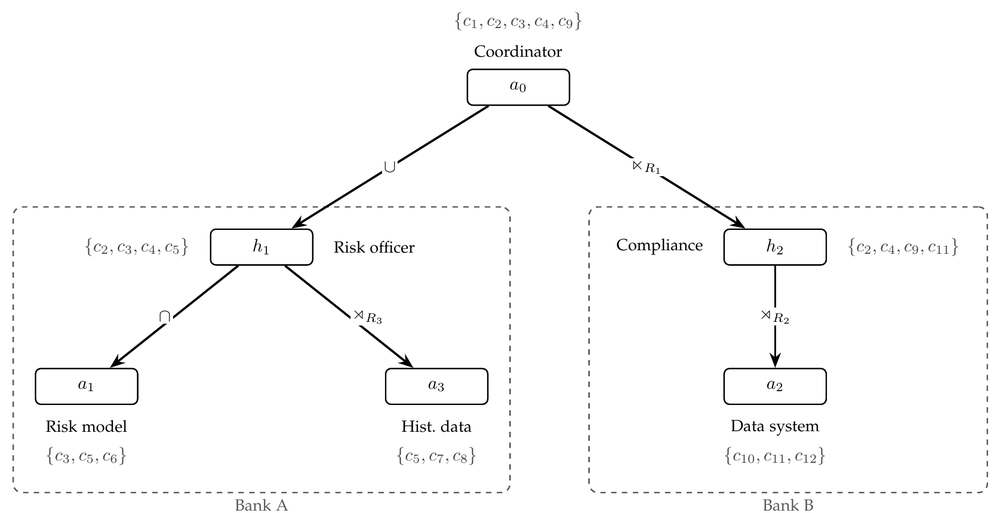
AI Agents and Human-AI NetworksThis is what I do for a living now. Since 2021 I work on AI for financial regulation at FINRA, the organization which oversees broker-dealers in the United States. I build systems based on Large Language Models: AI agents which read and analyze financial and regulatory documents, multi-agent platforms where specialized agents take care of different stages of one pipeline, and the tools which are necessary to check that all of this actually works — evaluation methods, benchmarks and synthetic data. Most of this work is internal and there is not much that I can show here. But it brought me to a question which I could work on in the open. Existing authorization frameworks assume that a human delegates authority down to an AI agent, and that adding an actor to a chain can only narrow what the chain is allowed to do. In real networks agents hold credentials which no human gave them, start workflows without a human prompt and collaborate across organizations which share no chain of authority. There a new kind of failure appears: an intermediary placed on a path "to be safe" can silently remove a credential which nobody else holds and which the task needs. Every local policy is obeyed, no component misbehaves, and the existing formalisms cannot even express what went wrong. In The Game of Peers I introduce a credential algebra where human and AI actors are structural peers. Each actor carries a set of credentials, and these sets are combined by operators (intersection, union and two joins) on the edges of a directed graph. Classical delegation is recovered as a special case: intersection on a rooted tree. The picture on the right is the worked example from the paper. The results tell when adding an actor is guaranteed to be harmless, give an exact criterion for a "destructive intermediary" — an actor whose presence takes away more than it brings — and show how hard these questions are computationally: deciding whether an actor can ever be destructive is NP-complete already on very small trees, while evaluating a given coalition takes linear time. One practical conclusion is that the cost of oversight lies in where it is placed, not in the fact that it is present. The paper is under review at the Journal of Computer Security. The preprint and a reference implementation are available on Zenodo. Related articles:Y. Ryabov "The Game of Peers: Toward a Credential Algebra for Human-AI Actor Networks", Zenodo preprint (2026), pdf with reference implementation |