

|
|
|
|
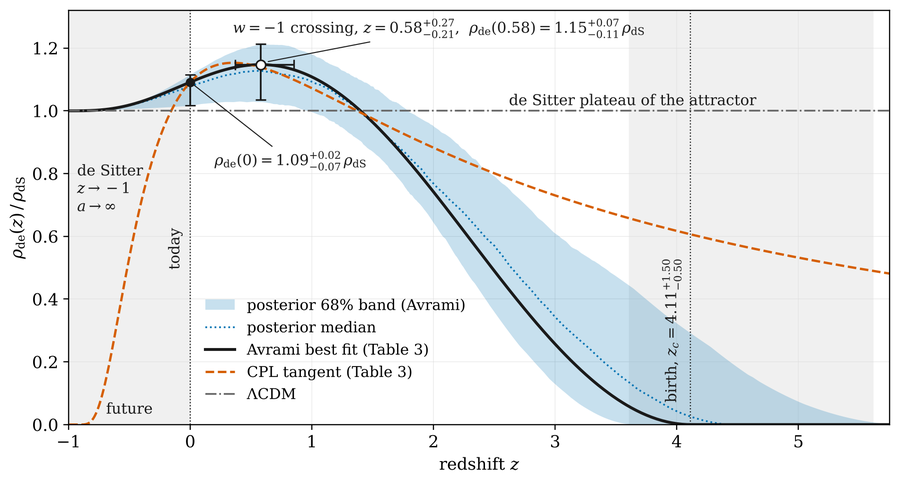
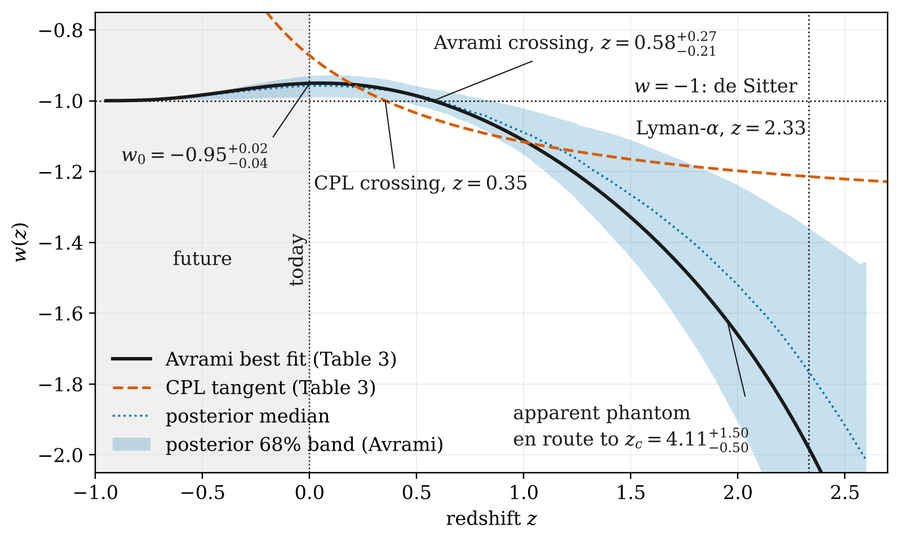
Cosmology: Dark Energy and the Cosmological HorizonThis is not my day job. It is sort of a hobby: what I do when I can save some time from my main activity. It started in 2026 as a speculative note and grew into an analysis of real data. The first note argues that the cosmological constant Λ is the thermodynamic signature of the cosmological event horizon. Starting from the Unruh effect and the holographic bound one recovers the observed density of dark energy as thermal energy associated with the horizon, with no free parameters. The same picture gives a present-day equation of state w ≈ −0.89 which never crosses w = −1, and a time of equilibration comparable with the present age of the Universe — which is one way to answer the question "why now?". The ingredients are not new: Jacobson, Cohen, Kaplan and Nelson, Li, Padmanabhan and others were there long before. The note organizes them into a single narrative. The second note is even more speculative, and its title says so. It asks whether the same horizon thermodynamics can account for the rest of the cosmic energy budget. The metric on a two-sphere decomposes under SO(3) into sectors with 1, 3 and 5 degrees of freedom. This leads to the prediction that the ratio of dark matter to baryonic matter is exactly 5 and, after quantization, to a route toward the gauge group of the Standard Model. The third work is where these ideas meet the data. I confront a family of dark-energy histories parametrized by the event horizon with Planck 2018, DESI DR2 baryon acoustic oscillations (including the 2026 Lyman-α update) and the Pantheon+ supernovae. The data build a ladder of conclusions: a fit with dark energy is decisively better than a fit without it; an evolving density beats a constant one; and dark energy which was born — absent at high redshift and switching on at z ≈ 4 — beats every eternal form. What the data cannot tell yet is how exactly this birth proceeded. The figures on the right show the best-fit history of the dark energy density and of its equation of state. All three texts are preprints which did not pass peer review. The code behind the third one is public. Related articles:Y. Ryabov "A ladder of conclusions on the history of dark energy: an inception at z ≃ 4 preferred by Planck, DESI DR2, and Pantheon+ data", Zenodo preprint (2026), pdf with code Y. Ryabov "Matter Content and Gauge Structure from the Symmetries of the Cosmological Horizon — A Speculative Note II", Zenodo preprint (2026), pdf Y. Ryabov "Horizon Thermodynamics and the Cosmological Constant: A Holographic Dark Energy Note on Why Now?", Zenodo preprint (2026), pdf |